
 I wrote this post last year on Pentecost while reflecting on my mission trip to Belize.
Some thirteen weeks ago, I was sitting in George Bush International Airport in Houston with sixteen of my fellow Franciscan students and with Fr. Gregory Plow, T.O.R., when I heard the call to board our plane to Belize. This was my first time leaving the United States and going to a foreign land. I dutifully pulled out my brand new passport to show to the representative of the airlines. This beautiful document was embossed with all the dignity and authority of human law at its best. "The Secretary of State of the United States of America," it said, "hereby requests all whom it may concern to permit the citizen of the United States herein named to pass without delay or hindrance and in case of need to give all lawful aid and protection." It was a simple sentence, but it spoke of cooperation, of friendship between nations and peoples, of protection given, under the law, even to foreigners. And yet, yet, there was something bazaar about the need to present papers merely to travel from one place to another. No such papers were needed to travel from place to place within the United States, and the whole affair had the air that international travel was a possible threat both to traveler and destination. The passport spoke words of peace, but they were words of a need for protection, of the possibility of delay, of hindrance.
I boarded the plane and proceeded to look out in awe as I traversed God's creation, flying through the air. The day was very clear at 35,000 feet and as I looked out, the very horizon itself vanished while we glided over the Gulf of Mexico. I soon, however, stopped paying attention to the window of the plane, satisfied that one part of the Gulf of Mexico looked very much the same as many other parts, and began to become engrossed in my book. Presently, however, I heard a clamor among my fellow passengers and realized that we had sighted land and would soon land in Belize City. I got out my passport again, and this time also got out the customs forms that I had carefully filled out and signed, complete with their obscure, arcane questions about imported plants and food. Presumably, if brought into the country, the plants and food could pose a danger to the local ecosystem, or perhaps also, to the local economy. Once I got off the plane, I and my fellow missionaries were checked to ensure that we weren't carrying anything contrary to the customs rules. The cooperation, even among allies, was, in some ways, at the point of a gun.
The next day, and throughout the following week, however, I experienced a lesson in contrasts. That Sunday night, we stood among a group of over a hundred people in a large building. The people were sitting in long, poorly supported, wooden benches and also lined along walls. There were old women, small children, hairy armed men, all speaking Spanish to one another. And, there we were, in the midst of them, a group of eighteen Americans, most of whom knew very little Spanish, standing right next to one another. A man, dressed in white robes, moved to the front of the room, stood up facing the rest of the people, and made a few remarks in Spanish. So far, of course, there seemed to be no contrast at all to the events of yesterday. This was, seemingly, a group of Americans who were now strangers, pilgrims in a strange land. But that was merely an appearance, for when the man finished his brief, opening remarks, he took his right hand, and glancing his forehead with it, touched it to his lower chest and then to his left and right shoulders, all the while saying, "En el nombre del Padre y del Hijo y del Espíritu Santo," to which the whole gathering of people, Americans included, responded, "Amen." The event, of course, was the Sacred Liturgy, and it was in this Sacred Liturgy in which I first realized concretely and in a new way the mystery we celebrate on this day, the mystery of Pentecost.
 In the Old Testament, God had confused the languages of man at Babel to check man's pride and to restrain the forces of evil in God's good world, those forces which opposed God's plan for mankind and especially for his servant Israel, but the Old Testament makes it clear that this strange confusion of languages was not meant to be the last word on the situation of man. Man was not made merely to scatter, but also to gather. The solution to the scattering, to the confusion of languages of Gen 11, had to do with the plan God himself set in motion in Gen 12 for Abraham and his descendents: "By you all the families of the earth shall bless themselves." (Gen 12:3)
The divine answer to the scattering of man abroad throughout the earth is the phenomenon of pilgrimage. Of course, in many places in the Old Testament pilgrimage is seen as something that is for the twelve tribes of Israel: "Jerusalem, built as a city which is bound firmly together, to which the tribes go up, the tribes of the LORD, as was decreed for Israel, to give thanks to the name of the LORD." (Ps. 122:3-4) The feast of Pentecost was one of the great pilgrimage feasts on which all the people of Israel were obliged to go up to Jerusalem. Nonetheless, the prophet Isaiah spoke of a time when, through God's purposes for Israel, all nations would engage in pilgrimage:
The word which Isaiah the son of Amoz saw concerning Judah and Jerusalem.
It shall come to pass in the latter days
that the mountain of the house of the LORD
shall be established as the highest of the mountains,
and shall be raised above the hills;
and all the nations shall flow to it,
and many peoples shall come, and say:
"Come, let us go up to the mountain of the LORD,
to the house of the God of Jacob;
that he may teach us his ways
and that we may walk in his paths."
For out of Zion shall go forth the law,
and the word of the LORD from Jerusalem.
He shall judge between the nations,
and shall decide for many peoples;
and they shall beat their swords into plowshares,
and their spears into pruning hooks;
nation shall not lift up sword against nation,
neither shall they learn war any more. (Isa 2:2-4)
Keeping this in mind we are brought to the great pilgrimage recorded in Acts 2.
Luke's intention in writing this could not be more clear: through the Spirit given as a result of Jesus' death and resurrection, the phenomenon of Babel is being reversed; God himself is undoing the confusion of languages and uniting the human race, but in his own divine way. This divine way is the proclamation of the gospel, the Good News that Jesus is Lord and therefore the machinations of injustice, of wrong, of sin, of death, the powers of evil, are not. They have been defeated by the death and Resurrection of the Lord's Christ.
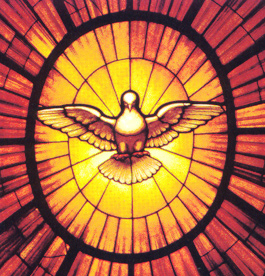
When the day of Pentecost had come, they were all together in one place. And suddenly a sound came from heaven like the rush of a mighty wind, and it filled all the house where they were sitting. And there appeared to them tongues as of fire, distributed and resting on each one of them. And they were all filled with the Holy Spirit and began to speak in other tongues, as the Spirit gave them utterance.
Now there were dwelling in Jerusalem Jews, devout men from every nation under heaven. And at this sound the multitude came together, and they were bewildered, because each one heard them speaking in his own language. And they were amazed and wondered, saying, "Are not all these who are speaking Galileans? And how is it that we hear, each of us in his own native language? Par'thians and Medes and E'lamites and residents of Mesopotamia, Judea and Cappadocia, Pontus and Asia, Phrygia and Pamphylia, Egypt and the parts of Libya belonging to Cyrene, and visitors from Rome, both Jews and proselytes, Cretans and Arabians, we hear them telling in our own tongues the mighty works of God." (Acts 2:1-11)

St. Paul speaks in several ways of this definitive triumph, but two of them figure in most prominently to the particular experience that I and my fellow missionaries had at mass that Sunday night in Belize. The first is that Paul speaks of the Church as God's temple, a temple in which Jew and Gentile are reconciled and in which both offer up a clean sacrifice to God (c.f. Eph 2:11-22; 1 Cor 3:9-17; 1 Cor 10:19-21). "So then you are no longer strangers and sojourners, but you are fellow citizens with the saints and members of the household of God, built upon the foundation of the apostles and prophets, Christ Jesus himself being the cornerstone, in whom the whole structure is joined together and grows into a holy temple in the Lord; in whom you also are built into it for a dwelling place of God in the Spirit." (Eph 2:19-22) The second way that Paul speaks of the Christ's victory in the Church is to refer to her as one Eucharistic body (1 Cor 10:16-18). "The cup of blessing which we bless, is it not a participation in the blood of Christ? The bread which we break, is it not a participation in the body of Christ? Because there is one bread, we who are many are one body, for we all partake of the one bread." (1 Cor 10:16-17) In this case, the many are one because they participate in the one Eucharistic bread. But a parallel and reverse view of the Eucharistic unity of the people of God could also be taken, a view taken in an early Christian work called the Didache: "As this broken bread was once scattered on the mountains, and after it had been brought together became one, so may thy Church be gathered together from the ends of the earth unto thy kingdom; for thine is the glory, and the power, through Jesus Christ, forever."
These two early Christian themes join together to show how God's victory in Jesus is ultimately, among other things, a victory over the confusion of languages in Genesis 11 by means of a fulfillment of Isaiah's prophecy of universal pilgrimage to Jerusalem. The first theme, that of reconciliation and temple building, shows that Christians of all nations and peoples are in fact being incorporated into God's New Temple, thus bringing them to the very heart of the sacrifice that is offered in that Temple. The second theme, that of the one Eucharistic body, works in a double way. First, in the sub-theme of unity through participation in the one bread, we can see that all of God's people are united through participation in the Eucharistic Bread and Wine, the Body and Blood of Christ. Alternately, in the subtheme of the formation of bread out of many parts that had been scattered, both Israel's return from exile and the streaming of Gentile pilgrims to Jerusalem are presented as parallel and interrelated themes which are recapitulated and brought to fulfillment in the Eucharistic offering.
Some small bit of this is what I and my fellow missionaries experienced in Belize. Before the beginning of mass, we could not know what was going on or what was being said, but when mass began we were able to follow along and participate with full minds and giving hearts, even though we did not always know what was being said. This is partially, of course, a result of the fact that the form of the mass is universal across the world. But, in a deeper and more mystical way, it was a result of the fact that the same sacrificial meal, the same participation in the one sacrifice of Calvary re-presented on the Church's alter, the same memorial of that sacrifice, the same sacrifice of the Church, that is to say, in sum, the selfsame action, is happening in all the Catholic Churches across the world when the mass is being offered. Thus, when we were at mass with the people of Belize, there was no division of mind and heart, even though there was still a diversity of languages. We were all participating in one Kingdom action, nay, in the very Kingdom itself. This was a participation with no need for passports, with no checking of identification, with no perceived danger to each other or to God's good creation. We had a true unity, presaging and indeed initiating and participating in the perfect unity of the world to come.
Indeed, the fruits of this unity, the koinonia, were present throughout the week. One thinks of several other New Testament themes: the collections taken in one Church to mutually assist other Churches, the mutual strengthening of faith by visits to other Churches, even the writing of letters between Christians in various places, all the sorts of themes which loom large in the New Testament, were the kinds of things that we experienced throughout our trip to Belize. It was not some kind of patronizing experience of colonialism or triumphalism, in which the know-it-all Americans go to bear the "white man's burden." Quite to the contrary, it was an experience of mutual edification, of mutual building up, that is to say, of koinonia, of communion. What the Belizian people received from us, they best can tell. But I can tell you some of the many gifts that I received from the Belizian people. I appreciated the way in which they always greeted each other with a polite and kind acknowledgment of each others being: a kind look and a gentle "good morning," "good afternoon," "good night." I appreciated their kindness and their openness to talking to us and to sharing themselves with us. I appreciated the slower, more laid back and relaxed pace of their culture. I appreciated the way in which a small child, like the boy Ethan who I got to play with throughout the week, could accompany his mother to work and could be a part of the school community. I appreciated 1001 other small things, and I thank the people of Benque for them with all my heart. I hope that I shall one day be able to repay the people of Belize for a small portion of what they have given to me, and I pray that the koinonia, the communion, that I experienced there and that I still experience with them every time I attend to the Eucharistic sacrifice, may always grow and become evermore stronger until we all meet in the Jerusalem above, which is our mother (Gal 4:26).


No comments:
Post a Comment